best transcription software for qualitative research
Best Transcription Software for Qualitative Research
Qualitative researchers need more than a fast transcript. The best workflow protects participant data, preserves speaker turns and timestamps, applies a consistent verbatim convention, and produces files that can move into NVivo, ATLAS.ti, MAXQDA, or a manual coding system. Vibe can provide a free local transcription step, but it does not replace human verification or qualitative analysis software.
What qualitative research transcription software must do
Choose software around the ethics protocol and analysis plan, not only advertised accuracy. A useful transcript must remain traceable to the recording while being easy to clean, anonymize, and code.
Process sensitive recordings locally when the consent plan requires it.
Keep timestamps and speaker turns available during verification.
Export an editable master before importing an anonymized analysis copy.
Document the app version, model, language, and review decisions.
Recommended research workflow
- Confirm consent, retention, and approved storage before transcription.
- Create a protected working copy with a neutral participant ID.
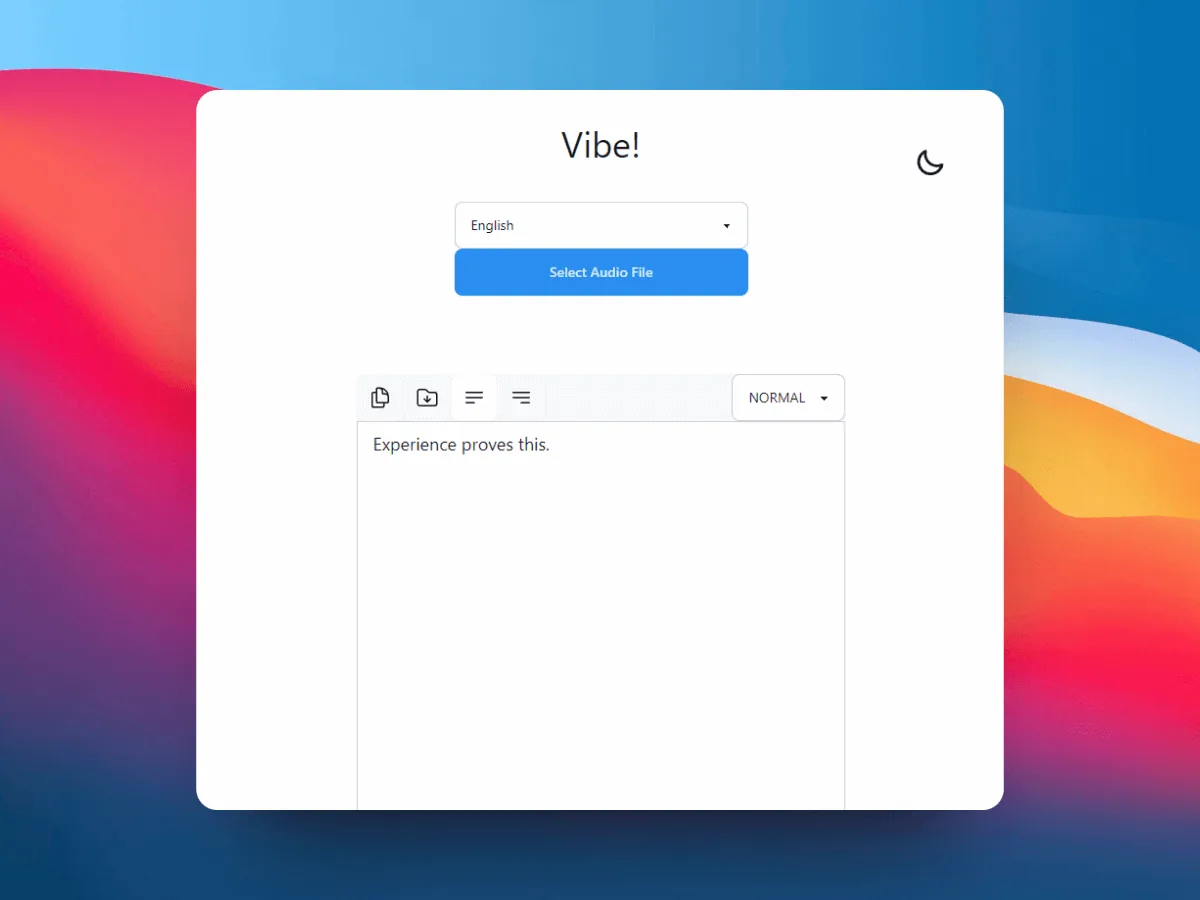
- Test a short sample in Vibe and check language, model, and speaker settings.
- Review names, numbers, quotations, overlaps, and speaker boundaries against the audio.
- Create a reviewed master and a separate anonymized analysis copy.
- Export DOCX, TXT, JSON, SRT, or VTT for the next research tool.
Which transcription approach fits the study?
Match the method to confidentiality, budget, turnaround, audio quality, and available review time.
| Approach | Best fit | Main advantage | Main limitation |
|---|---|---|---|
| Vibe local transcription | Sensitive interviews on a controlled computer | Free, open source, local processing | Researchers manage review and files |
| Cloud AI service | Teams needing browser collaboration | Fast sharing and editing | Uploads may conflict with data rules |
| Human service | High-stakes quotations or difficult audio | Context-aware review | Higher cost and more data handling |
| QDA platform transcription | Teams inside one analysis suite | Direct connection to coding | Cost, lock-in, and privacy terms |
Vibe is a transcription and export tool, not a qualitative coding platform.
Start with ethics, consent, and data location
Recordings may contain names, health details, workplace information, or sensitive opinions. Verify what the consent form, ethics review, sponsor, and institution allow. Vibe processes transcription on the researcher’s computer after models are available, but local processing is not automatic compliance: encryption, access control, backups, retention, and deletion still matter.
Define a transcription convention first
Decide whether the study needs full verbatim, intelligent verbatim, or a summary transcript. Define how to mark pauses, laughter, uncertainty, interruptions, inaudible passages, and nonverbal events before multiple researchers begin editing. Consistency makes later coding and quotation review more defensible.
Review speakers, quotations, and timestamps
Automatic transcription and speaker diarization create a draft, not verified research data. Similar voices, overlap, accents, noise, and specialist vocabulary can change words or speaker boundaries. Listen to every quotation that may be published, participant identifiers, and passages where interpretation depends on emphasis or timing.
Prepare files for qualitative analysis
Keep one reviewed master transcript and create a separate anonymized analysis copy. DOCX or TXT is practical for many coding workflows, JSON preserves structure for custom processing, and SRT or VTT keeps timing aligned with media. Test one import before processing an entire study.
Accuracy limits and quality control
Accuracy varies with microphone distance, echo, overlap, language, accent, model choice, and technical vocabulary. Pilot the complete workflow on two or three recordings, estimate review time, refine the convention, and move difficult files to a trained human transcriber when necessary.
Official references
FAQ
Qualitative research transcription questions
Is Vibe suitable for qualitative research interviews?
Yes, when a researcher needs a local draft and will review it. Vibe does not replace consent procedures, anonymization, quality control, or coding software.
Can Vibe transcribe focus groups?
It can transcribe multi-speaker audio and supports speaker diarization, but overlapping voices and similar speakers require careful manual checking.
Is local transcription automatically confidential?
No. Local processing reduces routine uploads, but confidentiality still depends on device security, storage, backups, access controls, retention, and the approved protocol.
Which export format is best?
DOCX or TXT is usually easiest for review and import. JSON preserves structure, while SRT or VTT keeps timing aligned with audio or video.
offline transcription with vibe
download vibe and start with a short local transcription test.
Download Vibe